





Environmental Management Declaration
- Basic Approach
- Restructuring of Promotion Activities (Revision to 'Responsible Care (RC) Basic Policy (Basic Policy on Health, Safety and Environment)')
- Environmental Management Promotion Policy
- Environmental Management Promotion System
- Environmental Issues and Action Guidelines
- Environmental Indicators (Achievement Targets for Major Issues)
In light of recent global changes in the environmental landscape, the NICHINO Group has announced the "NICHINO Group Environmental Management Declaration" and declared its commitment to continuously work toward further advancement of environmental management (September 2026).
Basic Approach
Nihon Nohyaku was founded as a company specialized in agrochemicals and will soon celebrate its 100th anniversary. At present, as a life science company with agrochemicals at its core, we have always faced environmental issues throughout our history. Since our agrochemical business, which forms the foundation of our management, is closely related to the environment and ecosystems, we consider the coexistence of business development and the natural environment to be indispensable for sustainable growth. In recent years, diverse environmental issues have become apparent on a global scale. Therefore, we will restructure our existing promotion activities and clearly articulate our promotion policies and guidelines anew, addressing these as part of the 'Raising the Level of Environmental Management,' which is identified as a materiality issue in the NICHINO Group's sustainability management.Restructuring of Promotion Activities (Revision to 'Responsible Care (RC) Basic Policy (Basic Policy on Health, Safety and Environment)')
Appropriate responses to recent environmental issues have become an important and indispensable component of our Group's growth strategy. Therefore, among the Responsible Care (RC) related activities we have been undertaking, we partially revised the 'Basic Philosophy on Environment, Safety, and Health' and its 'Code of Conduct' (established in 1993), and renamed it as the 'Responsible Care (RC) Basic Policy (Basic Policy on Health, Safety and Environment).' We also developed specific action guidelines for major environmental issues and expanded our promotion policies (2026).Environmental Management Promotion Policy
The NICHINO Group promotes business activities that emphasize environmental consideration to protect safe and stable food supplies and enriched lifestyles. Additionally, through environmental education, we work to deepen each employee's understanding of environmental issues facing our company and society, while continuously raising awareness. We fulfill our roles and responsibilities as a member of the chemical industry, strive to enhance corporate value through environmental management, and contribute to sustainable agricultural development and the resolution of social issues.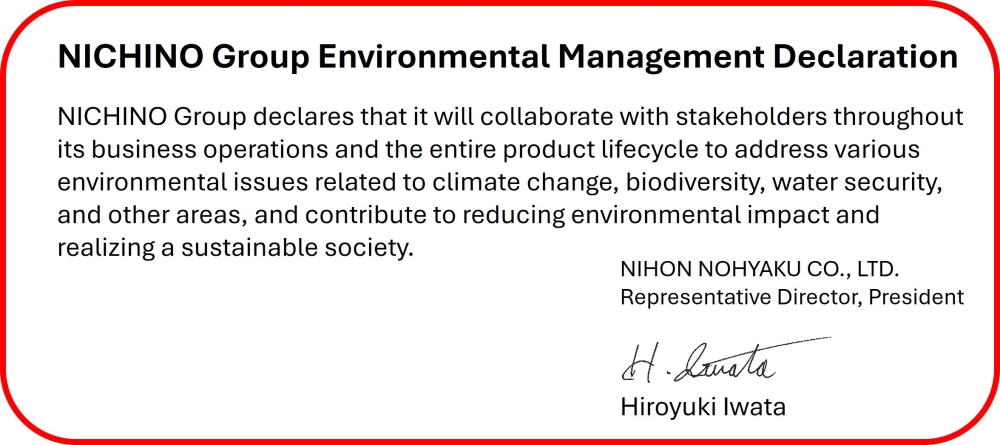
Environmental Management Promotion System
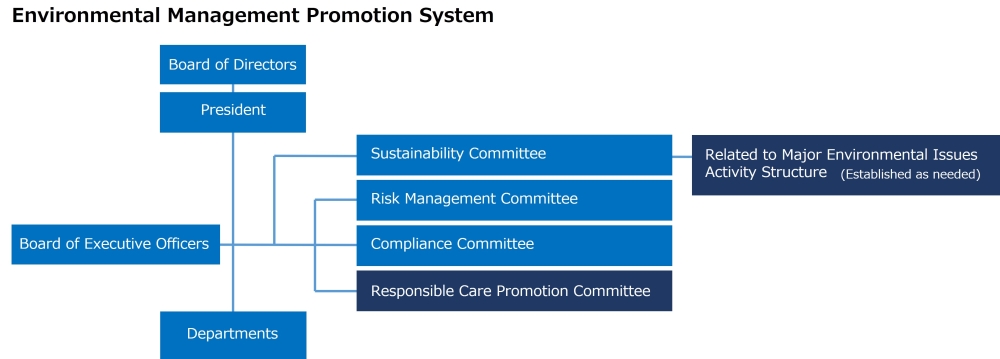
Environmental management is overseen by the Responsible Care (RC) Promotion Committee (chaired by the officer in charge of the Environment Safety & Quality Assurance Department) and is comprehensively implemented based on the seven RC Codes* established by the Japan Chemical Industry Association (JCIA), a general incorporated association. Additionally, major environmental issues are efficiently promoted in collaboration with working groups established as needed under the Sustainability Committee. The results of these activities are regularly reported to the Executive Committee and the Board of Directors, ensuring integrated promotion with management in connection with the materiality (Raising the Level of Environmental Management) in sustainability management (see figure below).*: Six individual themes (environmental preservation, security and disaster prevention, occupational safety and health, logistics safety, chemical and product safety, and dialogue with society) and the Management System Code for unified operation of these themes
Environmental Issues and Action Guidelines
Based on our past measures for addressing environmental issues, we have developed specific action guidelines from the perspective of the current importance of each issue.(1) Response to Climate Change (Initiatives Based on TCFD)
- Recognizing climate change as an important management issue, we are working toward the transition to a decarbonized society with the goals of reducing GHG emissions and achieving carbon neutrality.
- Through energy conservation, utilization of renewable energy, and efficiency improvements in production processes, we aim to achieve both environmental impact reduction and enhanced competitiveness.
- We will continue risk and opportunity analysis based on TCFD recommendations and build a business foundation resilient to environmental changes.
(2) Conservation of Biodiversity and Natural Capital (Initiatives Based on TNFD)
- Throughout the entire lifecycle of agrochemicals, we emphasize ecosystem impact assessments and develop products and technologies that consider biodiversity conservation.
- We focus on creating and expanding sales of Eco-harmonized products, with voluntary certification systems in mind, through improving the selectivity of active ingredients, reducing application rates, and suppressing environmental persistence.
- We will continue our response based on TNFD recommendations and strengthen the identification and management of dependencies, impacts, risks, and opportunities related to natural capital.
(3) Chemical Substance Management and Environmental Pollution Prevention
- We ensure environment, safety, and health throughout all processes related to chemical substances in our business activities, from exploration and development to disposal and recycling.
- We strive to manage the emission of chemical substances into the air, water, and soil, ensure proper treatment and reduction of waste, and minimize environmental impacts in the event of accidents or disasters.
- We comply with domestic and international laws, regulations, and voluntary standards regarding chemical substances, and maintain high global environmental management standards through proper information collection and sharing.
(4) Resource Circulation and Improvement of Environmental Efficiency
- We aim to improve the efficiency of water resources, raw materials, and energy use, thereby reducing environmental impact in our business activities.
- We contribute to the formation of a circular society through waste generation reduction and the promotion of reuse and recycling.
- We promote manufacturing process improvements and capital investments that contribute to reducing environmental impact.
(5) Creation of Environmental Value through Innovation
- We promote technological innovation that achieves both improved agricultural productivity and environmental conservation, contributing to the realization of sustainable agriculture.
- Through systematic initiatives such as smart agriculture and the utilization of digital technologies, we support the proper use of agrochemicals and reduction of environmental impact.
- Through the development and provision of new products, technologies, and services that can address environmental issues, we work to solve global food problems and environmental challenges.
