





Initiatives for Human Rights
- NICHINO Group’s Basic Approach to Human Rights Management
- Ideal business model for 2030
- Human Rights Management Promotion System
- Responding to Human Rights Respect Process Based on the UN Guiding Principles
- Common Approaches to Ensure Respect for Human Rights
NICHINO Group’s Basic Approach to Human Rights Management
NICHINO Group positions respect for human rights as one of the most important management issues for the sustainable promotion of business. We respect the internationally recognized human rights of all people and conduct business activities in accordance with the United Nations’ “Guiding Principles on Business and Human Rights” and “Ten Principles of the Global Compact.” We will fulfill our responsibility to respect the human rights of all stakeholders involved in the Group’s business activities.
Ideal business model for 2030
All NICHINO Group employees respect the human rights and diverse values of all people and contribute to the realization of a society free of discrimination and prejudice.

| Key Issues in Human Rights Management | Medium- and Long-term Initiatives |
|---|---|
|
|
| FY2024 Results | FY2025 Plan |
|---|---|
|
|
Human Rights Management Promotion System
Representative Director and President of Nihon Nohyaku is responsible for overseeing the Group’s human rights management, and the Division Manager of the Administration Division is responsible for implementing and promoting it. In addition, we have established a Human Rights Subcommittee under the Sustainability Committee to systematically and flexibly promote initiatives to ensure respect for human rights (Figure 1). The Human Rights Subcommittee comprises members from across the organization, including participation from related departments, and operates in coordination with three related committees (Table 1).
Figure 1: Human Rights Management Promotion System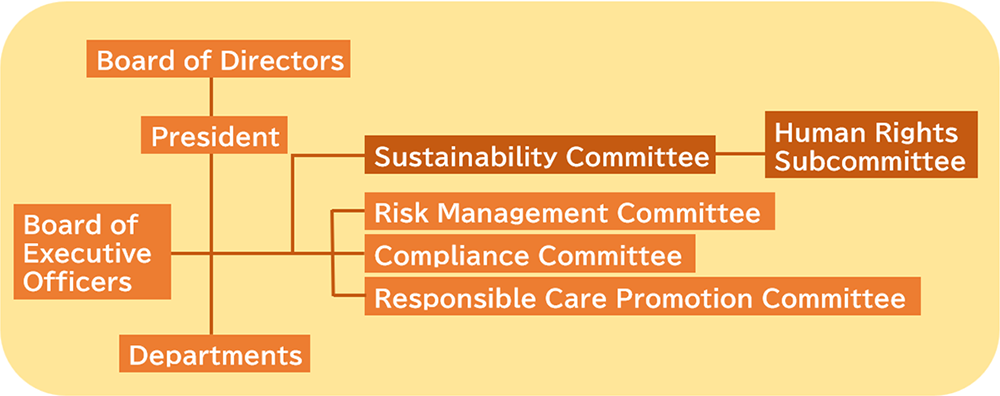
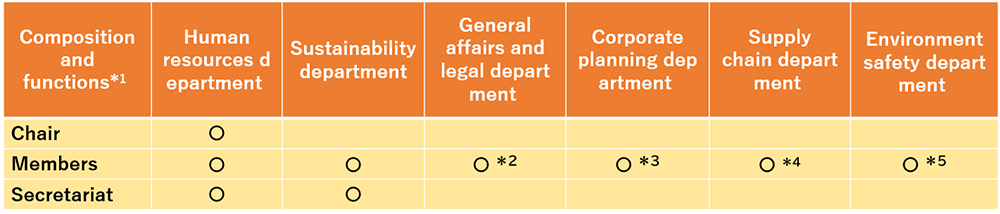
*1: In cooperation with the sections responsible for business at Group companies, including the Corporate Planning, Production, and Industrial & Pharmaceuticals Sales Divisions (in Japan) and the Overseas Division (overseas)
*2: Secretariat of the Compliance Committee
*3: Secretariat of the Risk Management Committee
*4: Department in charge of supply chain management
*5: Secretariat of the Responsible Care Promotion Committee
Responding to Human Rights Respect Process Based on the UN Guiding Principles
NICHINO Group is pursuing initiatives in line with human rights due diligence processes prescribed for companies, based on the three documents*1 published by the Japanese government as domestic standards reflecting the United Nations Guiding Principles.
*1: Japan’s National Action Plan (NAP) on Business and Human Rights (2020-2025) (Inter-Ministerial Committee on Policy Promotion for the Implementation of Japan’s National Action Plan on Business and Human Rights, 2020) , Action Required Today of Companies to Address Business and Human Rights (Human Rights Bureau, Ministry of Justice, 2021 and 2024) , and Guidelines on Respecting Human Rights in Responsible Supply Chains (Inter-Ministerial Committee on Policy Promotion for the Implementation of Japan’s National Action Plan on Business and Human Rights, 2022)
1. Formulation of the Human Rights Policy
The new NICHINO Group Human Rights Policy (April 2024), which further specifies the scope and content of the previous Basic Human Rights Policy (established in May 2021), has been formulated to expand human rights management based on the Group’s Sustainability Basic Policy.
- Please refer to the NICHINO Group Human Rights Policy for more details.
- Please refer to the Sustainability Basic Policy for more details.
2. Human Rights Due Diligence Study on Negative Impacts (Human Rights Violation Risks) in Business and Human Rights
Identification of Human Rights Violation Risks at Nihon Nohyaku
The Human Rights Subcommittee secretariat conducted a review of human rights-related risks within our existing business risk management framework. We also held workplace discussions on human rights risks with all employees, communicated with the labor union, and conducted interviews with external experts to ensure comprehensiveness and objectivity as we progressively identified risks of human rights violations. As a result of this process, we identified 18 human rights violation risks and their relationships with the affected rights holders (Table 2; FY2024).
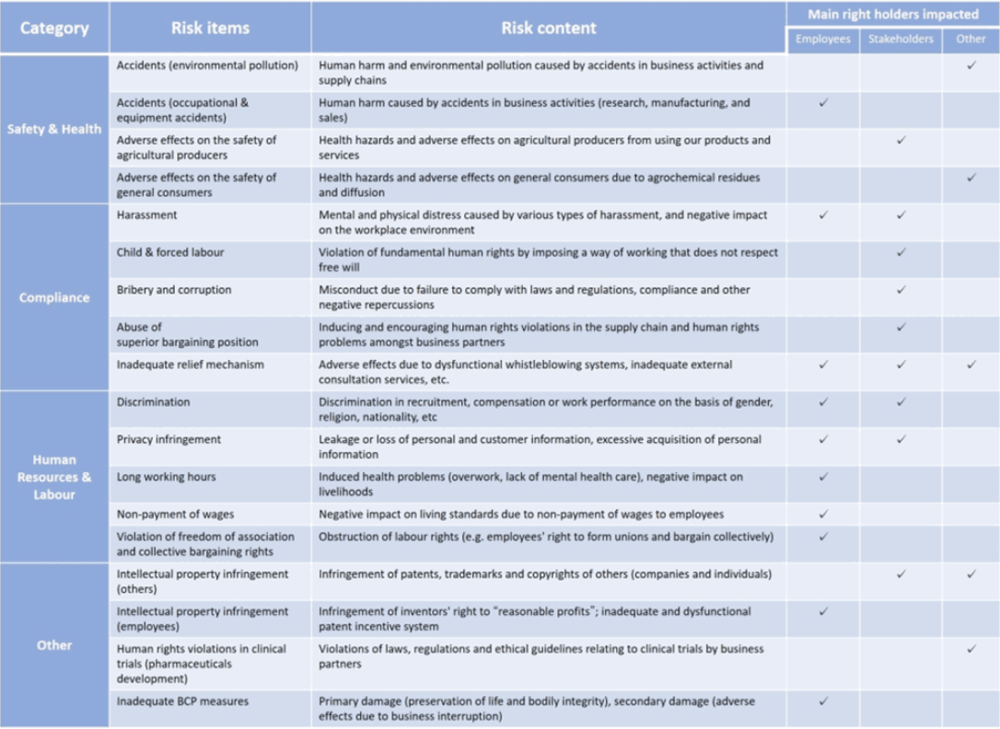
*Classification of affected rights holders
Employees: all employees working on NICHINO Group's sites. Including contractors, outsourced workers, etc.
Business stakeholders: entire value chain (suppliers, customers, business partners)
Other: local residents, consumers and the general public
Analysis of the Importance of Human Rights Violation Risks at Nihon Nohyaku and Response to these Risks
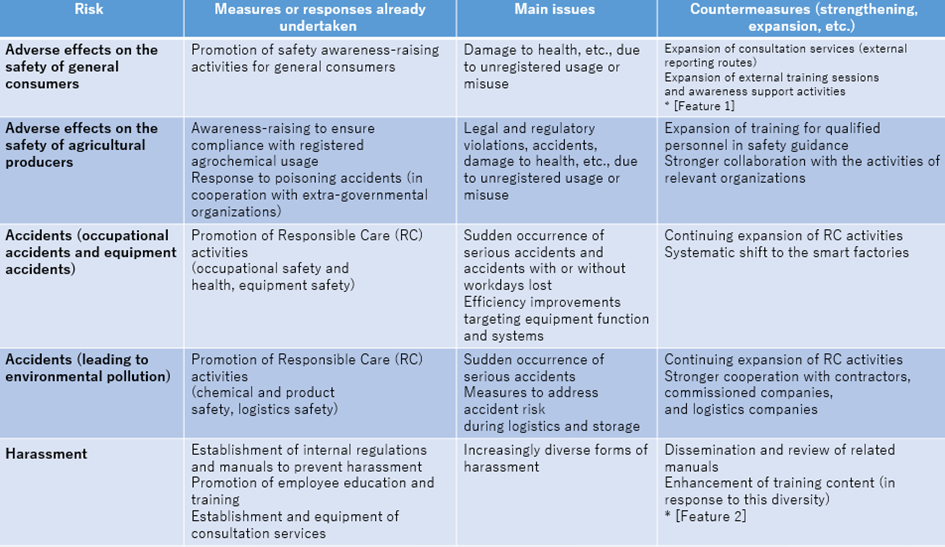
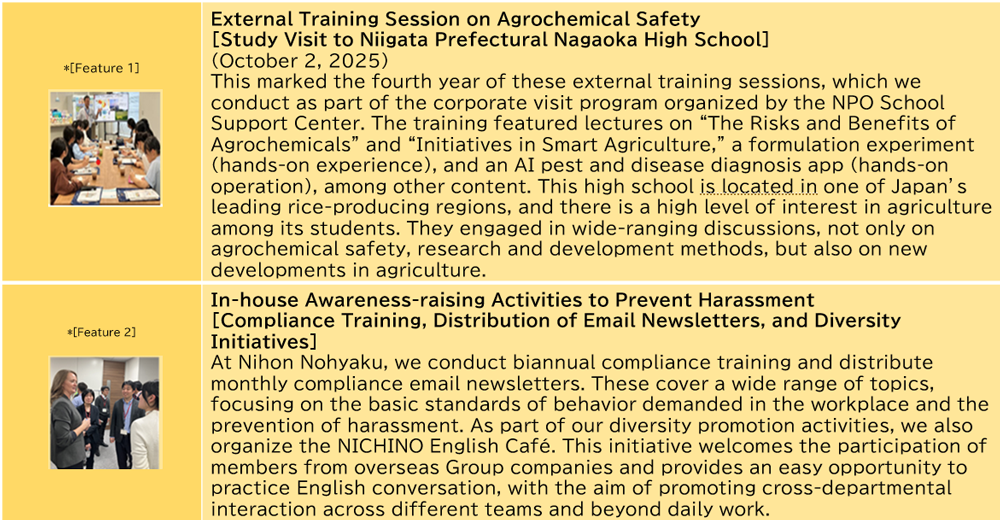
We analyzed the importance of the 18 identified human rights violation risks based on the decision criteria in the government guidelines*2 (FY2024). We are working together with the relevant departments to share the past measures taken and our future approach for all human rights violation risks. We have also ascertained the specific status of measures to address the five risks with the highest level of severity, in particular (Table 3).
*2: Reference Material on Practical Approaches for Business Enterprises to Respect Human Rights in Responsible Supply Chains (2023)
Confirmation of Human Rights Violation Risks at Group Companies
As a strategy for promoting human rights management at Group companies in Japan and overseas, we have surveyed each company for the presence of any of the 18 human rights violation risks identified by Nihon Nohyaku(Table 2). As a result, although we found some risks originating from each company’s specific business activities and regional characteristics, we were ultimately able to verify that each of these could be consolidated into one of the 18 identified risks. At this point, we have not recognized any new or additional human rights violation risks, and we have confirmed that our existing list of 18 risks is comprehensive (FY2025).
Analysis of the Importance of Human Rights Violation Risks at Group Companies and Response to these Risks
As a result of this analysis of importance, we found that the human rights violation risks identified by Nihon Nohyaku also ranked highly among many Group companies. However, the priorities and status of each company’s response display unique characteristics due to differences in business form and scale, as well as national and regional conditions. The main risks considered to be of high importance for domestic and overseas Group companies, other than those shown in Table 3, are as follows (Table 4). We will reorganize priority issues according to the characteristics of each company and progressively strengthen initiatives in line with each company’s actual situation, in the future.
Table 4: Important Human Rights Violation Risks at Domestic and Overseas Group Companies
| Group companies | Main risks considered of high importance (other than Table 3: excerpt) |
|---|---|
| Domestic (4 companies)* | Long working hours, Inadequacies in BCP measures, Abuse of a superior bargaining position, Invasion of privacy |
| Overseas (10 companies)* | Long working hours, Inadequacies in BCP measures, Invasion of privacy, Violation of intellectual property rights, Bribery and corruption, Discrimination, Child labor and forced labor, Failure of relief mechanisms, Violation of freedom of association and collective bargaining rights |
*Domestic (4 companies): Nichino Ryokka Co., Ltd., Nichino Service Co., Ltd., Nihon Ecotech Co., Ltd., AgriMart Corporation
*Overseas (10 companies): Nichino America, Inc., Nichino Europe Co., Ltd., Taiwan Nihon Nohyaku Co., Ltd., Nichino do Brasil Agroquimicos Ltda., Nichino India Pvt. Ltd., Sipcam Nichino Brasil S.A., Nichino Vietnam Co., Ltd., Nihon Nohyaku Andica S.A.S., Nichino Korea Co., Ltd., Nichino Chile SpA
3. Relief Mechanisms
Nihon Nohyaku, together with its domestic and overseas Group companies, has established a whistleblowing system for all officers and employees. In FY2025, we also established external whistleblowing and consultation services (inquiry forms) targeting human rights violation risks in the supply chain. At the same time, we have asked our domestic Group companies to establish similar services, with four of them targeting completion within FY2025. No reports or consultations have been received so far. In the future, we aim to improve service effectiveness by raising awareness and creating an environment that facilitates their use. From FY2026 onward, we plan to progressively establish services and multilingual support for major overseas Group companies as well, with full consideration for local laws, regulations, and response systems (Table 5).
We will operate human rights due diligence and relief mechanisms in an integrated manner and continue to promote initiatives to ensure respect for human rights.
Table 5: Establishment of Services at Group Companies
| Group companies | Establishment or planned establishment |
|---|---|
| Domestic (4 companies) | Established at 3 companies; establishment planned at 1 company in FY2025 |
| Overseas (10 companies) | Local surveys undertaken in FY2025 Services (including multilingual support) to be progressively established from FY2026 onward, mainly at key companies |
Common Approaches to Ensure Respect for Human Rights
At Nihon Nohyaku, we have reviewed the Human Rights Subcommittee’s promotion system and functions (FY2025) based on the revised human rights due diligence processes published by the Japanese government.*3 Through this review, we have strengthened the system to ensure effective and consistent processes.
*3: Action Required Today of Companies to Address Business and Human Rights (Human Rights Bureau, Ministry of Justice, 2024)
1) Implementation of education and training
The Group conducts ongoing awareness-raising activities for officers and employees concerning the risks of human rights violations, with the aim of achieving a deeper and more accurate understanding and recognition of respect for human rights. In addition to compliance training and the distribution of email newsletters, we strive to create a range of opportunities for officers and employees to enhance their knowledge, such as recommending participation in external seminars. In promoting DE&I, we seek to deepen their understanding of the importance of diversity and the expected outcomes of these efforts, and to ensure DE&I is embedded throughout the organization.
2) Development of internal environment and systems
The Group strives to create a work environment that is free from long working hours, discrimination, and prejudice, which are all factors that pose the risk of human rights violations. In addition, we ensure the establishment of our fair personnel system and its fair operation to properly facilitate increasingly diverse work styles.
3) Ensuring human rights throughout the supply chain
The Group promotes comprehensive initiatives to ensure respect for human rights throughout the supply chain from the perspective of sustainable procurement. In Japan, we use the CSR procurement Self-Assessment Questionnaire (SAQ) provided by the Global Compact Network Japan (GCNJ) to assess our business partners’ situation and identify risks.
4) Dialogue with stakeholders and information disclosure
We engage in ongoing dialogue and consultations with diverse stakeholders, exchanging views with external experts, engaging in discussions at labor-management council meetings, and ensuring timely and appropriate information disclosure. At the labor-management council meeting held in February 2024, we discussed and formulated a human rights policy. At the labor-management council meetings held in August 2024 and January 2026, we discussed human rights management (the progress of due diligence). Through constructive dialogue with stakeholders, we will continue to steadily promote initiatives to ensure respect for human rights.
